One of my favorite quotes is from Michael Hammer, the father of reengineering: “Average people in a great process will outperform great people in an average process every time.” I am always looking for “great processes” in the field of creative problem solving. Tim Hurson’s book Think Better has an excellent example called What’s Going On? When I first read Tim’s book (it has become a favorite), I asked my partner Jack to “story board” the process, and Tim graciously gave me the ok to post Jack’s illustrations.
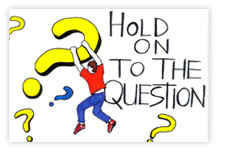 Hold on to the question
This isn’t really part of the process but is key to understanding the importance of being “okay with the ambiguous, being ok with not knowing” in order to get to the really great answers. As Joyce Wycoff says in her book on mind mapping, “great ideas are not like cream to be skimmed from the top; they are “bottom feeders” and it takes a divergent/convergent process to find them.
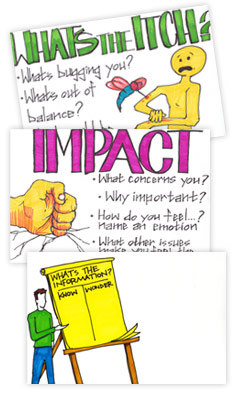 What’s the itch?
“Here we investigate the need for the new idea in the first place. What’s wrong, what could be better, what’s out of balance, what needs improvement?” (Think Better by Tim Hurson)
What’s the impact?
Once you’ve settled on the most important itch to resolve (and Tim tells you how to do that with convergent thinking), delve into why is this Itch so important?
What concerns you? How do you feel about this itch?
What’s the information?
Hurson introduces a simple but powerful tool here called KnoWonder. The questions in this part of the process help create an “information platform on which to build.” Listing all the known “facts” and needed information also helps a team see where they have agreement and where they differ on the data.
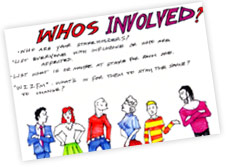 Who’s Involved?
So far, you and/or your team have looked at the Itch from an internal point of view. Now it’s time to identify your stakeholders and the impacts of the Itch on them. Key questions here include turning to everyone’s favorite radio station, WIIFM. What’s in it for the stakeholders if things change and what are the benefits to them of keeping things the same?
 What’s the Vision?
Here Hurson introduces the concept of Target Future. He explains a method for “capturing the dream” or an “itchless future” by using sentence stems such as “It would be great if…or if only… Once you or your team has identified a long list of potential Target Futures, Think Better suggests a convergent process for identifying where the group’s energy is focused and what it the most important Target Future to begin action planning.
And now the real work begins!! There are many more processes and tools in Think Better. And the best news is when I met Tim at at the Atlanta Creativity Conference in May, he talked a bit about his new book coming out soon. If it’s as good as Think Better, I can’t wait!!
Tweet